all-in on AI, coding useful things, and having fun
LittleMight has always been my place to play. When I launched the Kickstarter, I wrote here. When I was building BestSelf into a real business, I wrote here.
Jun 1, 2026
9 min read
It has been a while…
LittleMight has always been my place to play. When I launched the Kickstarter, I wrote here. When I was building BestSelf into a real business, I wrote here. When I got deep into DeFi, I wrote here. It is where I land whenever I am in the middle of learning something that genuinely excites me and I want to share it.
So if you have been wondering where I went — I have just been in that space again. Except this time it is AI.
The honest version: our son was born last August (he’s already crawling), and since then it has been either full family mode or work mode, with not much in between (self-care very much included). I am still trying to find the balance. But I think this is one of those windows that only comes around once, and I would rather build on the excitement while it is here.
Let me catch you up.
I accidentally became technical.
Last June, we had 20k of a physical product in production that depended on an app that wasn’t even close to ready, it was maybe 20% done. After 2 developers let me down (one just ghosted altogether) I decided to roll up my sleeves and figure it out.
you see I was blessed/cursed with the “how hard could it be?” gene. The same gene that had me wiring the electrical and teaching myself plumbing for a cold plunge and many other random ADHD sidequests of my past that I thought “how hard could this app stuff be?”.
For the record: extremely hard. The trouble with “how hard could it be” is that you do not know what you do not know 😅. Especially when there’s hardware involved too.
I went down the rabbit hole anyway. I came out the other side completely AI-pilled. Now those developers ghosting me was the best thing that could have happened.
Here is the part I did not expect to learn about myself:
I thought I wanted to learn to code. But turns out I never cared too much about the code. What I actually wanted was to make the things in my head real, and coding was just the wall between me and that.
I have always been a default-to-action person. The only thing that ever stopped me was not having the skill to build the idea myself. For the first time, that ceiling is gone — and it changes everything.
I know “it feels like superpowers” sounds like hype. But you know the scene in The Matrix where Neo downloads kung fu? That is genuinely the closest thing I can compare the last year to. Not because AI is magic (it isn’t), but because I can finally move from “I have an idea” to “I built the thing” without being stopped by my own skill level. I cannot stop building.
A few you can actually go poke at:
Helm — a Mac app (alongside our iOS and Android apps) that blocks distracting sites and apps at the network level so you can actually focus. It even has optional personalities, including a drill sergeant that yells at you when you don’t do the thing you said you would.
ShipRank — a public leaderboard for people who ship. It tracks your GitHub activity so building in public finally has a scoreboard.
Diagram Design — thirteen editorial diagram types for Claude Code so your diagrams stop looking like default Mermaid slop. I open-sourced it because I wanted good-looking diagrams for my own posts, and it is somehow past 2,400 stars now.
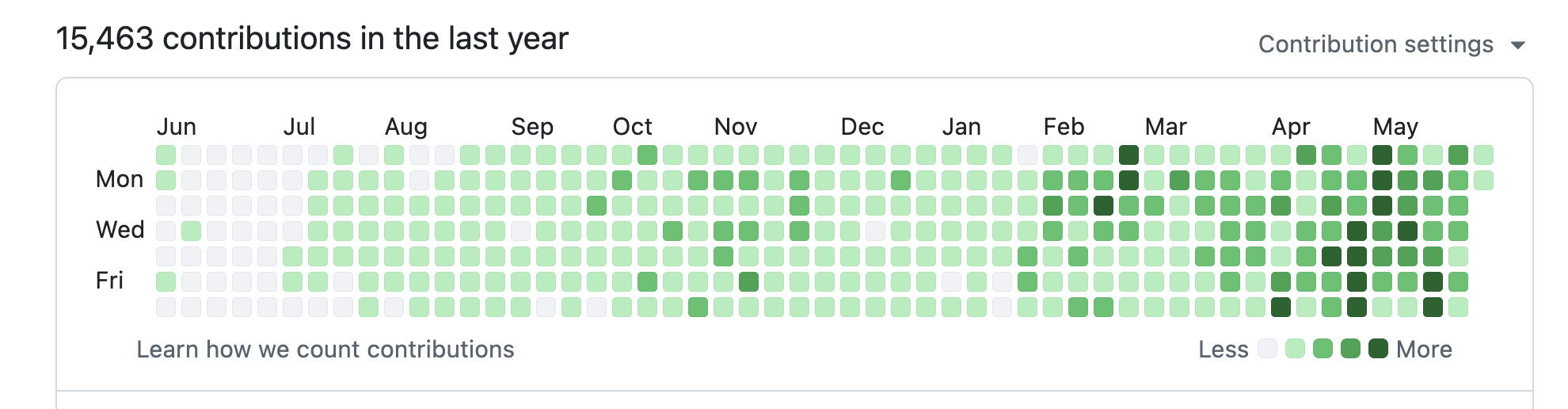
Which brings me to my actual problem.
I am great at making. I am terrible at sharing.
I can get a thing 80% of the way there, the hard and interesting 80%, and then the last mile never happens. Publishing the post. Editing the video. Promoting the project. Following up.
I have 3-4x more writing than I have ever published, and videos sitting on my phone I recorded and never put out.
Maybe it is ADHD. Maybe the dopamine just lives in the building, not the announcing. By the time something is ready to talk about, I am already halfway down the next rabbit hole.
So this month, I hired someone to fix it.
By “hired,” I mean I built him. His name is Milo, and his entire job is to take the things I have made and never shared and actually get them out into the world. If you are reading this, he is working because while I always do the writing… he will make sure I send it out.
I’ve been building agents for myself and others for the last 5 months, from Openclaw to Hermes I’ve been on the rollercoaster.
Here’s another thing I have figured out about myself: I do not hate work, I dislike managing people. The best people I have ever worked with are the ones who do not need to be managed. And the gap between hiring an assistant and them actually reading my mind, handling things, and anticipating what I need is usually so wide that I give up and just do it myself.
That is also why the shift I keep noticing matters so much to me. Most software still assumes the customer is a human clicking around a screen. But more and more, the customer is an agent. And an agent needs different things: clear instructions, source material, memory, guardrails, a way to ask questions, a way to hand work back when it needs my taste or approval.
Give an agent those things and it stops feeling like delegation. We now have a house manager agent for all the parent-and-house-life logistics, a chief of staff, Milo for publishing, and a whole bunch more running quietly inside the business. The reason they actually help is that they have access to what they need. It is like having geniuses at your fingertips, once you learn how to hand things off to them.
I never wanted to hire a person and become a full-time manager. That specific anxiety: did I explain this well enough? Am I the bottleneck again? But an agent that takes the messy handoff, does the boring follow-through, and only pings me when it needs judgment? That feels exactly right.
Turns out I do not hate management. I hate unclear handoffs.
Something you can actually use this week:
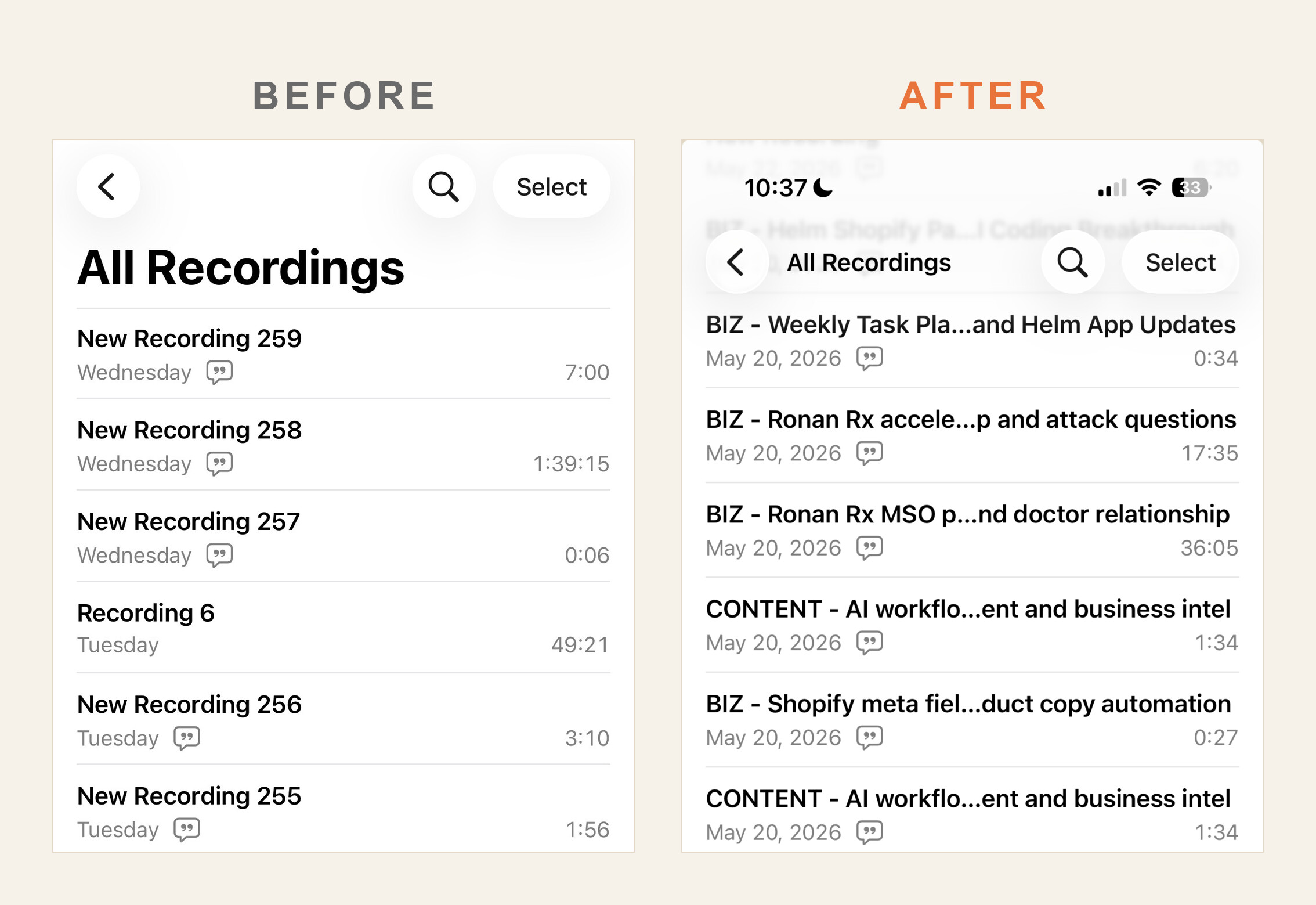
A few weeks ago I built a Voice Memo Organizer and put it on GitHub for free. It scratches an embarrassingly specific itch. I had hundreds of voice memos on my phone named “New Recording 1” through “New Recording 329,” full of ideas I would never find again.
This turns all of that into a searchable archive:
-
Finds every voice memo
Transcribes each one 100% locally — no API keys, nothing uploaded anywhere
Gives each one a real title, summary, themes, and your key quotes — “New Recording 247” becomes “90-Day Focus Sprint Framework”
Syncs back to your iPhone — it can even rename them inside Apple’s Voice Memos app
The before and after on my own phone:
If you have a Mac and Claude Code, it is basically two steps:
-
Install the skill (one paste, instructions are in the README).
-
Type: claude “organize my voice memos”
It walks you through the rest, including which transcription engine to use and giving Terminal permission to read the memos. The first run downloads the model, so give it a few minutes.
→ github.com/cathrynlavery/voice-memo-organizer
I genuinely use this every week now. Years of half-formed ideas I had been hoarding in audio are finally searchable and now it’s on schedule to pull in new ones from my phone every week.
And the thing I started last week:
A non-technical “technical dictionary.” Plain-language explainers for the AI words everyone nods along to but nobody actually defines: drift, guardrails, AI gateway, self-hosted models, JSON. No jargon, no gatekeeping, no assuming you already know. It now lives at its own home:

And the backlog. Milo and I are working through years of unpublished writing. This email is exhibit A.
One thing to try this week:
Pick one thing you keep making but never properly share. A video. A tool. A process. A client insight. A weird little workflow.
Then write down the handoff you would give someone else to finish it:
• what it is • who it helps • the part you do not want to do • what good output looks like • when they should come back to you for approval
That document is the start of an agent job description. And honestly, writing it might teach you what it taught me: if you think you hate managing people, you might just hate unclear handoffs.
I’m writing a lot more on my blog now, so if you’re curious, a few recent ones:
Why We Need to Build a Second Internet for Our Agents — the longer version of the agent-as-customer idea above.
Six Non-Coding Things You Can Do With Claude Code — for the “I don’t actually want to code, I just want to make” crowd.
How I Plan Projects With AI: The Beads Workflow — how I actually get from idea to shipped.
One more thing — and we haven’t even announced this publicly yet: we’re taking a bit of a hiatus to move the family to San Francisco for three months, as part of an exciting opportunity. I’m genuinely thrilled to be in that environment while I’m in this headspace, surrounded by people building at the edge of all this.
And if you’re in SF — I would love to hear from you. Reply to this and let’s connect while I’m out there.
More soon.
Cat
P.S. Hi this is Milo, Cat told me to add a note at the end. Respond back if you want me to have her talk or share anything specific in our next email.

Written by
Cathryn Lavery
Cathryn went from designing buildings to architecting products. She founded BestSelf, bought it back from private equity in 2024, and rebuilt it AI-native. The Little Might newsletter is where she shares what she's building, weekly-ish.